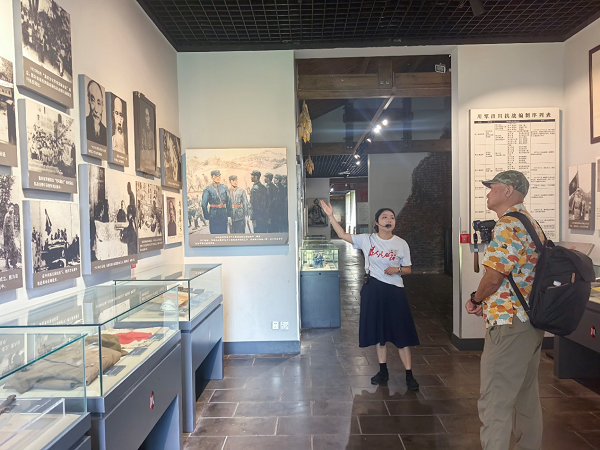
On July 15, travel enthusiast Jack Yang spent four hours visiting the Jianchuan Museum Cluster in Dayi County in Chengdu, capital of Southwest China’s Sichuan Province.
Wu Xi, a young docent shows Jack Yang (right) photos pertaining to the Sichuan Army’s resistance efforts during the Chinese People’s War of Resistance Against Japanese Aggression (1931-45).
The senior teacher from Wuhan University in Wuhan, capital of Central China’s Hubei province, has driven around the world.
A sophisticated old-timer with broad knowledge, he exclaimed that the owner of the cluster which covers more than 33 hectares is amazing.
“If it were someone else, this museum could never have been built,” he said.
Fan Jianchuan, 69, is the owner of the cluster in Anren Town in Dayi.
Known as the Museum Town of China, more than 1,400-year-old Anren is famous for its 27 well-preserved mansions primarily built by wealthy landlords between the 1920s and 1940s during a period of profound social change.
The grand residences blending Chinese and Western architectural styles are very impressive.
The Jianchuan Museum Cluster, which was set up by Fan Jianchuan, a former soldier, real estate billionaire and vice-mayor of Yibin in Sichuan, opened to the public in 2005.
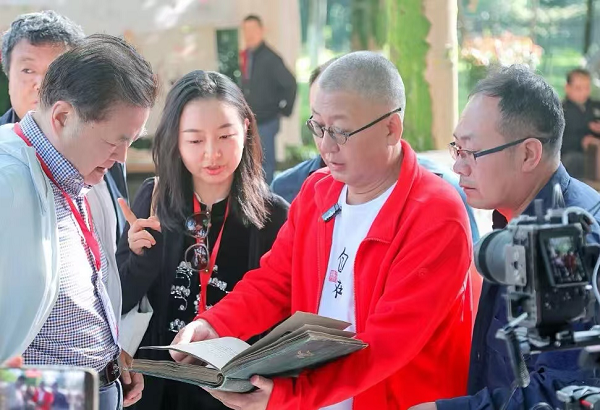
Fan Jianchuan (second from right) and cultural heritage experts from Chongqing China Three Gorges Museum examine a collectible.
The cluster has received more than 37 million visitors ever since, according to Liu Ronghua, head of the cluster’s general office.
To Fan’s friends, the cluster is his career and his life, so much so that he jokingly calls himself a “slave” to his museums.
“People need someone to sound the alarm and remind them of their history, and I’ve always wanted to be that bell ringer,” Fan says.
Fan has traveled all over the world collecting the exhibits.
Some are as small as a bracelet or a seal, others as large as a 10-metric-ton blockhouse of Japanese troops when they invaded China.
His dedication paid off, and the cluster now owns over 10 million artifacts, including nearly 7,000 national precious cultural relics, although less than 1 percent are on display due to reasons of space.
Among the most popular exhibits are those related to the Chinese People’s War of Resistance Against Japanese Aggression (1931-45), the “cultural revolution” (1966-76) and the magnitude-8.0 Wenchuan Earthquake of 2008.
The cluster, which is China’s largest private museum complex, boasts the nation’s richest collection of memorabilia and features exhibitions ranging from wartime memories to folk culture.
Its theme is “for peace, collect war; for the future, collect lessons; for peace, collect disaster; for inheritance, collect folk customs.” The message behind it is clear: never forget.
Some of the museums are visual statements in themselves.
The Prisoners of War Museum, for example, is built to resemble a prison.
A sliver of light streams in from a window set high in bleak, gray walls, illuminating an interior divided into cells by bars.
Lining the walls are stark images of Japanese atrocities against Chinese prisoners.
The result is deeply moving, as are the letters, artifacts and uniforms on display.
Shaken, visitors exit through barred gates to find themselves walking beside a peaceful pond. On one wall is a plaque bearing the smiling photo of a former prisoner of war, a reminder that war is about the sacrifice of individuals.
Although the temperature is very high at this time of year, visitors brave the scorching heat to visit the cluster.
Sharing Jack Yang’s sentiment, they are moved by Fan’s dedication to his cluster and decision to donate it to the State.
Fan has signed an agreement with the Chengdu Municipal Government to donate his cluster of more than 30 museums once he passes away.
The intention of donating the cluster is to let these collections which carry the memories of the nation truly transform from private possessions into the shared heritage of the nation and its people, Fan said.
Find more China Stories on China Daily app.
中国日报客户端供稿